
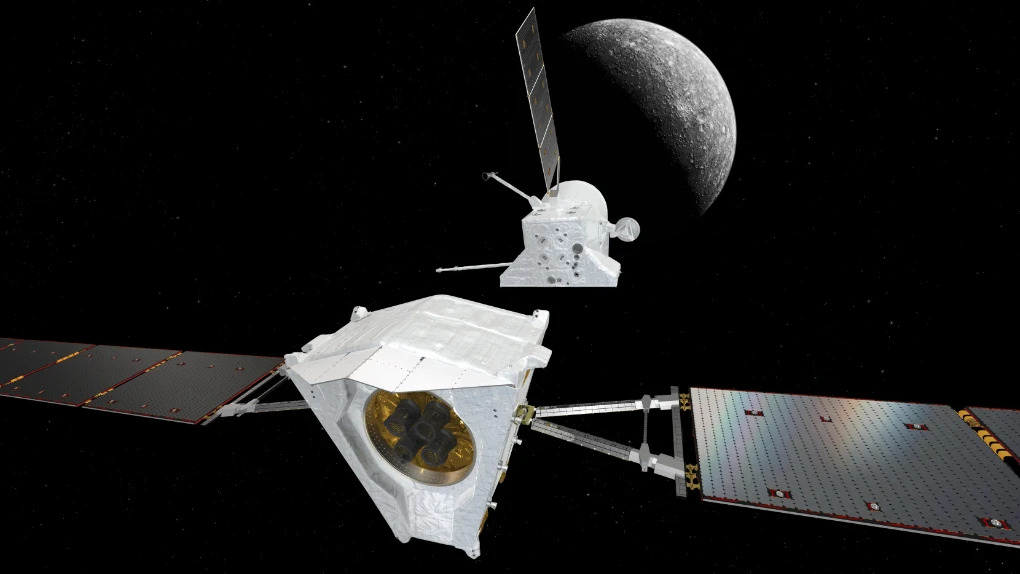
The European-Japanese BepiColombo probe is scheduled to enter orbit around Mercury on November 21, after an eight-year journey through the inner Solar System. According to ESA, it will be the first mission with two spacecraft in orbit around Mercury at the same time.
The mission is led by the European Space Agency in collaboration with the Japanese agency JAXA. The European MPO spacecraft and the Japanese Mio are traveling together and will separate on December 9 and 10. Scientific work is scheduled to begin in April 2027.
Mercury is closest to the Sun, but exactly because of this, it is difficult to reach. According to ESA, the Sun’s strong gravity accelerates the probe as it flies toward it, and achieving a stable orbit around Mercury requires more energy than a mission to Pluto.
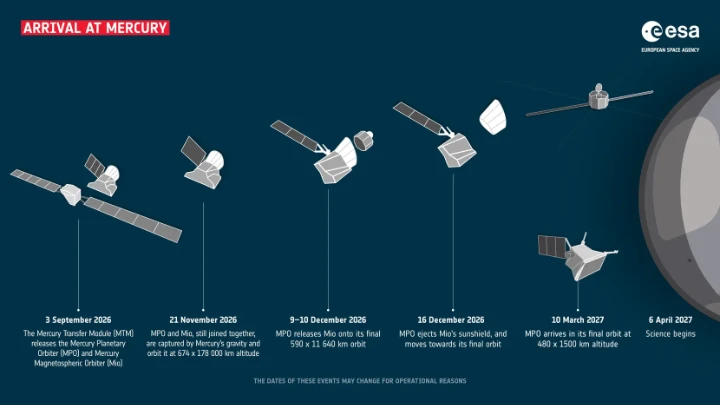
Because of this, BepiColombo, launched in October 2018, has traveled 9.9 billion kilometers and made nine planetary flybys: one past Earth, two past Venus, and six past Mercury. These flybys helped it lose energy and slow down, as doing so with engines alone would be extremely difficult.
Most of the journey was made possible by the MTM module with ion engines, which use solar energy to convert xenon gas into plasma. In April 2024, a power supply issue reduced their thrust, so ESA had to adjust the trajectory. The engines were turned off in June, and the module separated on September 3, 200 million kilometers from Earth.
Now the maneuvers are being performed by the European spacecraft using its chemical engines. ESA says that the arrival is not a single event, but a six-month series of maneuvers—one of the most complex planetary arrival sequences the agency has ever undertaken. MPO’s instruments were turned on in September and, according to initial analyses, are in good condition.
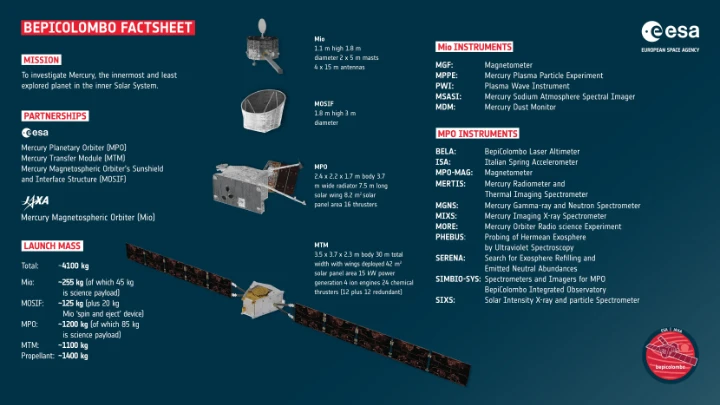
BepiColombo is only the third mission to visit Mercury, following NASA’s Mariner 10, which flew by it three times in 1974 and 1975, and Messenger, which orbited the planet from 2011 to 2015. Mercury’s last transit across the Sun, visible from Earth, was in 2019, and the next will not be until 2032.
Mercury also hides a few strange things. Although the surface temperature climbs above 400°C, there appears to be ice in the craters that are permanently in shadow, and its core is exceptionally large for the size of the planet.
One day on Mercury, from noon to noon, lasts 176 Earth days, while a year is only 88.


