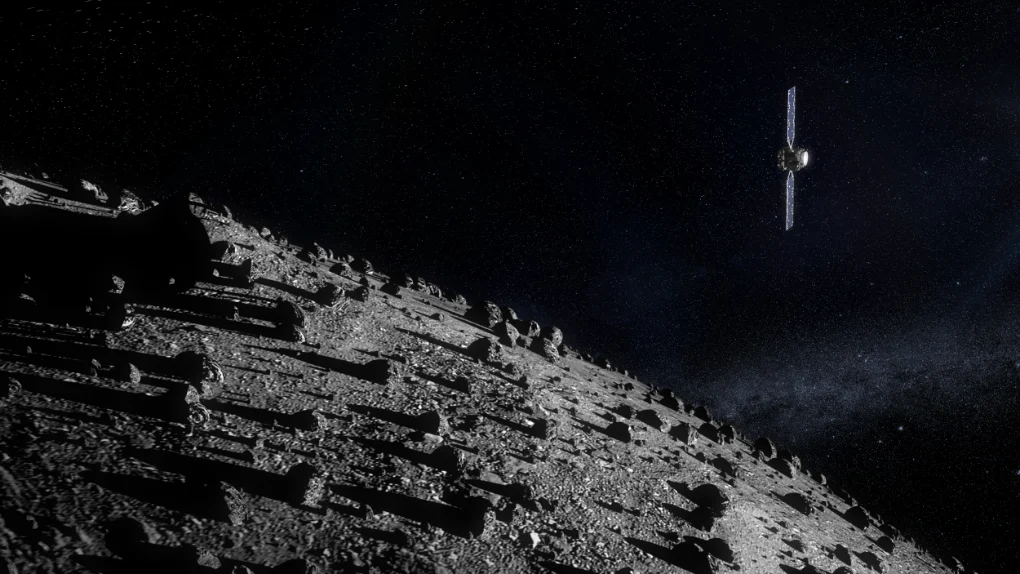
The European Space Agency’s (ESA) Hera spacecraft, after a two-year journey, has nearly reached the binary asteroid Didymos and its small moon Dimorphos. In 2022, NASA’s DART spacecraft deliberately crashed into Dimorphos in the first test of defending Earth from an asteroid, and Hera’s job is to study the impact site.
On November 12, ESA released a new image taken from 56 kilometers away. It clearly shows the larger asteroid Didymos, 780 meters wide, with a small part of the 151-meter-wide Dimorphos peeking out from its upper edge.
For comparison, according to ESA, Dimorphos is about the size of the Great Pyramid of Giza, while Didymos is slightly smaller than Dubai’s Burj Khalifa. The two asteroids are about a kilometer apart, and Dimorphos orbits Didymos at around 18 centimeters per second, slower than a human walking pace.
Didymos is shaped like a spinning top and rotates once every 2.2 hours. According to ESA, that is fast enough to bring it close to breaking apart, which may explain the surprisingly sharp ridge along its equator. Models suggest the rapid spin might be causing material to flow toward the equator, and it is possible that Dimorphos itself formed from material that broke away from the larger asteroid.
An earlier image from 60 kilometers showed a previously unseen side of Didymos. “The first thing we said was: wow!”, said Patrick Michel, the mission’s principal investigator. “This is the other side of Didymos from the one DART’s camera showed us just before impact, so it’s like looking at a whole new world.”
The 580-kilogram DART spacecraft struck Dimorphos on September 26, 2022, at 6.1 kilometers per second. The impact shortened its orbit around Didymos by about 33 minutes, far more than predicted, and NASA later confirmed the change. According to ESA, this made Dimorphos the first object in the Solar System whose orbit has been measurably changed by humans.
Still, the key questions remain unanswered. Hera needs to determine whether the impact left a crater or completely reshaped the asteroid, how massive it is and why the deflection was larger than expected. To do this, it will use several instruments and two small shoebox-sized spacecraft, and a landing is planned at the end of the mission.
The goal is to turn the impact from a one-off experiment into a well-understood technique that could be repeated if a dangerous asteroid ever really appears, as briefly seemed to be the case with 2024 YR4.
ESA will release the first detailed images of Dimorphos on November 25.