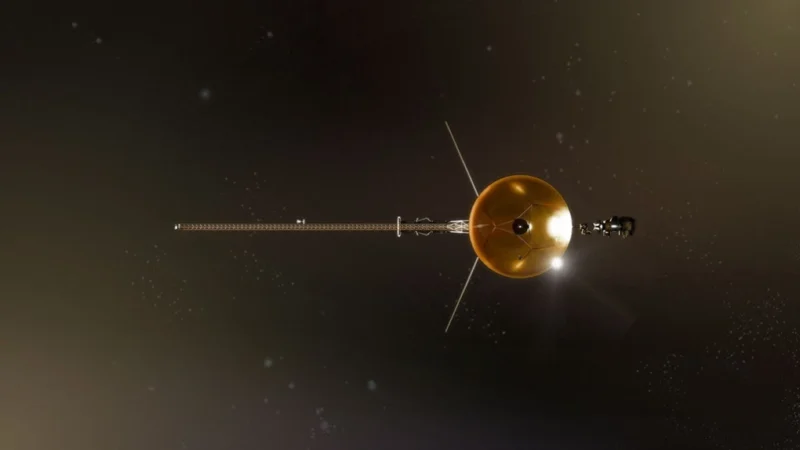
NASA has officially confirmed that Voyager 1 reached one light-day from Earth, but it also repeated that the spacecraft hasn’t sent any science or engineering data since Nov. 14. Voyager 1 passed the 16.1-billion-mile (25.9-billion-kilometer) mark on Wednesday at 5:16 a.m. ET, as we reported, and the team at JPL received the signal from that moment 24 hours later.
NASA disclosed the problem the evening before the celebration. On Nov. 14, a Deep Space Network antenna in Canberra, Australia, locked on to the spacecraft’s carrier signal, but there was no data in it. That means Voyager 1 is still pointed at Earth and its antenna and transmitter work, and according to NASA the issue likely lies with the onboard computer that collects data from the instruments and formats it for transmission.
Because of the distance, every command takes a day to reach the spacecraft and another day for the reply, so NASA warns that diagnosing the cause may take weeks or longer. Voyager 1 had a similar problem in 2023, when one of its computers was to blame, and the team is now checking whether there is a link to the roughly two-day loss of contact in October. After that gap, the spacecraft operated normally until Nov. 14.
The light-day milestone was confirmed using the carrier signal and trajectory calculations. NASA explains that the spacecraft travels at a constant speed and has no way to change it, so an engineering issue can’t affect when it crosses the line.
According to NASA, this year’s power-saving move, in which three devices on Voyager 1 were replaced with lower-power alternatives, is expected to keep the current instruments on both spacecraft running until at least their 50th launch anniversaries next summer. A JPL representative told Space.com that power margins remain “very thin,” since the spacecraft’s thermal state also has to be balanced. Suzanne Dodd, Voyager project manager at JPL, told Space.com the team doesn’t expect major changes to operations until then, but the article doesn’t mention the data outage at all.
Scientists would like Voyager 1 to last long enough to show where the Sun’s influence ends and pristine interstellar space begins. That now also depends on whether engineers can get the spacecraft sending data again.